Pages

seeking & creating : researching & discovering : applying & practicing

sustainability in design = changing mindsets + deeds
Showing posts with label DIY. Show all posts

Tuesday, April 21, 2015

Eleven Mutant Baby Doilies/Bejewelled Scabs - Conceptual Shoot


Concept: Imagining luxury fashion techniques applied as a luxurious skin disease or the idea of luxury fashion and cosmetics as a skin disease, death/disease/decay vs. embellishment/decoration/beautification.
Materials: kimono fabric scraps, crocheted 100% wool yarn, beads/semi-precious stones, applied with scar make-up on skin
Freehand machine embroidery and beading by Allison Bell
Beading and crochet by Adel Ng
Photography and post-production: Mel T
Make-up by: Nicki
Models: JacintaKat, Jess

Friday, September 7, 2012

Light/Soft Sculpture/Movement: DIY Possibilities & Inspiration

Due to major renovations to the family home, I have recently been paying more attention to interior design and home decor stuff, which has led to a hunt for eco-friendly/upcycling DIY options for certain singular items, such as light fixtures.

SO that's how it's done!

Pretty complex huh!

With the sheer trend in fashion still around, (it will always be around in bridal I guess?) it is also interesting to consider design ideas revolving around how elements of moving/travelling light, varying degrees of opacity and translucence, and sculpted material/fabrications interact with the movement of the human body...this reminds one of the experimental "emotional-sensing" SKIN clothing - integrated with moving light reactive to various environmental/physical changes-  that Philips Design was doing before...

The garments, which are intended for demonstration purposes only, demonstrate how electronics can be incorporated into fabrics and garments in order to express the emotions and personality of the wearer.
The marvelously intricate wearable prototypes include 'Bubelle', a dress surrounded by a delicate 'bubble' illuminated by patterns that changed dependent on skin contact- and 'Frison', a body suit that reacts to being blown on by igniting a private constellation of tiny LEDs.

 And the inspiration hunt went quite naturally in a more performance art direction...super-cool stuff...


Monday, August 29, 2011

DIY Magazine Stool & Recycled Paper Furniture

...wondering if it would also work with Yellow Pages with the sides painted, and straps made from elastic or discarded bag straps...the base is probably more tricky to source and perhaps needs some carpentry skills...

http://www.econesting.com/2011/08/10/diy-magazine-stool/

With all the paper waste that life generates, be it at work or at home, it seems a good/sustainable idea to find new and innovative ways to create raw material through recycling waste paper, use it for furnishing, thus effectively creating new product life-cycles without using up more virgin wood resources...

Perhaps the challenge is in durability and long-term functionality in view of daily wear/tear. Paper is still seen as disposable and/or not as strong as conventional furnishing materials such as wood/plastic/leather/etc. We have to rethink the concept of sustainability in our furnishings when considering waste paper as a new raw material.

Friday, April 15, 2011

Gorgeous Jacinta

Jacinta wears the upcycled electric violet tunic made from a second-hand 100% polyester tank top and ombre-dyed Thai silk scarf (also second-hand), trimmed with finger-knitted acrylic yarn cording...

Tuesday, March 22, 2011

Making and Re-making: a somewhat Photo-fanatical post

Pin-cushion with built-in pockets for bobbins, bobbin-cases, and feet, made from a shrunken beanie


Yes. Lots and lots of pictures. And an embarrassing confession: I keep my trusty little Panasonic camera on hand at all times, but am probably not as trigger-happy as an "aspiring blogger" should be.

And processing/editing/uploading/actual blogging takes a while too (held up by procrastination, of course).

Anyway, a little history of what went down not too long ago...

We did attempt to hold crafting/making sessions at the Richmond Library meeting/function room several times in February 2011, but sadly, the turn-out was rather low. Let's imagine a little tear rolling slowly down my cheek...was it bad timing, short notice, or Facebook being not quite the best way to organise events?

Ms. Bell the beading maestro in action

Even so, many thanks to Allison and Jackie (and Charani, for those few short moments) for coming by to keep me company while some of these projects were underway...perhaps one day Restructors will be able to hold crafting/upcycling/making jam sessions in real style...we can only hope!!!

Complete: little girl's multi-functional reversible pinafore/skirt with strap/sash options, made from remnents & scraps

Incomplete: reversible and dual-direction convertible hooded shrug-jacket with adjustable cuffs, turns into a scarf, also made from remnents and scraps


On a side note, documentation can be such a tiring process, isn't it? The creative working process needs to be evidenced in order to be exhibited, and the creation of evidence is another layer of labour unto itself. Thank goodness for this tree-saving online channel which renders the need for hard-copy printing unnecessary.

What is crucial about this documentation of processes is being able to show in a tangible form all the labour, diligence and thought that contribute to end-product creation.

Second-hand bright purple polyester tank top, approx. size 16, before destruction

Especially in the case of upcycling old/second-hand/discarded garments, where personally I feel a strong need to justify the act of destruction (cutting it up) and reconstruction, through the evidence. And this evidence must not only show experimentation and exploration, but also project a thoughtful and considered process which effectively involves eco-design and sustainability concerns.

Reconstruction stage: ombre-dyed second-hand Thai Silk scarf attached to tank, followed by attachment of finger-knitted acrylic yarn cording as trim, sewn on by hand...

I have to stress that by no means is this a perfect or flawless process, and honestly there is a huge amount of stress to produce an end-result with certain levels of wearability and aesthetic quality. Already, considering cradle-to-cradle fabrication standards, attaching silk to polyester/acrylic could be a big mistake. However, the deterioration of the silk fabric with wear and tear, contrasting in texture and sheen against the polyester over time, would be an intriguing process in itself...

Jackie models the reconstructed but incomplete tunic

The result is an asymmetrical garment that appears to have a different weight on the left and right side, resulting in one sleeve seeming longer than the other. Not having a discernible front or back (which was the intention) could make for an interesting, albeit disorienting, experience for the wearer...and the drape effect was a pleasant surprise.

Does it work? Is it too bulky? Is it ugly? Should more be done?

Another question: was this truly zero-waste? Not exactly. More like "minimal waste"; as in the process of unpicking the side seams and sewing on the silk scarf, some bits had to get trimmed off.

The doubts (one of many) lingering with this garment at present is when to stop; whether or not to insert drawstrings into both the sleeves so as to be able to adjust their length and the overall proportions of the garment itself.

What do you think?

Another line of exploration I have been trying out is arguably a process of "re-fabrication", which is essentially geometrically organised collaging of cut-up fabric scraps from sample books and remnents to form a whole new piece of material to work from, largely inspired by quilting, which was one of my late paternal grandmother's greatest skills.

Good collage or bad collage?

The issues here, outside of colour coordination headaches: combining synthetics with naturals (potential care/maintenance problems galore), construction (lots of bulky seams), and TIME. This process is experimental, excruciatingly slow/tedious and gets increasingly difficult as the size of the composite expands.

I am not even sure this is the best possible configuration of shapes, and probably never will be. The possibilities at this stage are already endless. And then, after these 2D shapes are sewn together, what 3D garment can be sculpted from this quilted piece? More possibilities...

Sunday, January 2, 2011

Construction Inspiration: Kirigami Papercraft

Papercraft has totally invaded my brain...not only inspirational, but also easy, simple, harkens back to childhood, and so much fun!
Cut-out chains of little horses for a store window backdrop-hanging (with a Spring Racing Theme) are transformed into a fascinating ornament with staples:

Before: 
Recycle Republic - I work here.
After:

Of course, there are heaps are resources online to inspire and guide you. The one site that got me going was Golics' channel on metacafe, which sort of makes one tempted to replace or cover all the ordinary lampshades in the house with kirigami structures. The moveable transforming 3D paper toys are amazing!


Experimentation with kirigami (beyond snowflakes and pop-up cards) can be a challenging exercise in mathematical precision and structural engineering, especially when attempting mobile, modular, 3D objects.

Of course, the art of kirigami easily lends inspiration to fantastic garment construction possibilities, which brings to mind the zero-waste cutting techniques of Mark Liu

Read more about this pioneer in Inhabitat's as well as Ecouterre's coverage of his impressive work

http://www.ecouterre.com/mark-lius-zero-waste-designs-use-every-last-scrap/


Even more exciting are the possibilities of combining origami and kirigami - folding, cutting and modular construction techniques, all based on simple geometrical shapes. Here are methods applicable towards the reduction of fabric waste, as well as utilising scrap/remnents/discarded pieces, all while you create animated new 3D structures from 2D materials and push the boundaries of convention in garment design...FUN.

Wednesday, December 15, 2010

Crazy Christmas Crafting

 
Seeing Papier d'Amour's old book-page paper wreath in Real Living Magazine has sparked off a wreath making craze especially since the whole world seems to be gearing up for Christmas madness!

I didn't even bother with Googling (though you will find lotsa eye-candy!) for DIY guides or instructions, but went for it instinctively, like the gutsy, impulsive craft-o-maniac I am. But if you like, this shows a how-to...

Basically, you need a circular doughnut-shaped base, strong glue, or strong double-sided or sticky tape, or perhaps stapler/staples, whatever it takes to make the paper attach to the circular base and not come off when the finished product is hung.

I do not have a glue gun (would be interesting to yank one out of my behind or out of my hip holster every time I needed one though!) so it was a pain to find enough super glue to make the rather large wreath I ended up with. (It measures around 60 or 70 cm across in diameter, yet another uncalculated result.) Having masking tape and a large stapler/staples on hand helped A LOT.

I ended up spending around $40 on the whole thing; half of the money went into getting the glue alone. The rest I spent on the tinsel ribbons and a small amount of pretty overpriced matte and metallic wrapping tissues and wrapping paper; also a roll of cellophane which I thought to use to wrap around the whole thing as dirt/weather protection eventually, but maybe not...

It was a good thing that I had ready and free access to heaps and heaps of discarded packing cardboard! And of course my own personal stash of cords, ribbons and trims to use when needed.


You need lots of loose paper pages, which can be twisted into loose or tight cylinders, cones, fans, ribbon shapes, loops, gathered and shredded, cut into cool shapes, made into 3D stars, whatever rocks your boat...but processing the pages can be tedious and repetitive...think of it as a calming therapy. I gathered the pages roughly after folding once diagonally, so no nice coiled cone formations in my wreath...


All I had on hand was an old issue of Marie Claire magazine (with Kristen Stewart on the cover, fancy that) and I knew that glossy magazine pages will have no colour consistency, unlike old book pages, so I was seriously considering getting a can of red or green sparkley spray paint to create a more consistent colour.

What I tried to do was make sure dark and light coloured pages were spread evenly about and mixed well with brightly coloured pages...though come to think of it, perhaps having a gradient of light-to-dark colours might be cool. Hard to achieve though! To create an even fullness, you need to spread the bunches around at intervals and slowly fill in gaps.


So the crazily textured result...


I keep wondering whether it looks too junky. Certainly looks rather insane!


And a couple more...

 From cardboard boxes used to package organic vegetables, and the inner tube of a roll of wrapping paper...

This one was for Sprout, an awesome health food shop and cafe next to where I work...


And a little over one issue of Grazia magazine from/for Tedesco III turns into...

Sunday, December 5, 2010

Inspirational Design/Construction

from: http://agendainc.com/blog/?p=1721

made by SOFTlab: http://vimeo.com/user1149720/videos

Watching this fascinating animation of a Paul Poiret dress construction, one cannot help but recall: this designer is arguably one of the primary 20th Century "liberators" of women's bodies from the confines of the corset/girdle.

(And perhaps a thorn among the roses, considering Vionnet, Lanvin and Chanel...which bring to mind the question: how many male designers really know how to dress women without enforcing various unattainable ideals upon them? Then again, does not fashion itself create and propagate unattainable ideals?)

He had his heyday 100 years ago, yet the shapes and designs of his garments are utterly modern, relevant, and present. Don't you also see endless DVF copies in this wrap dress design? True timelessness, in this fashion, seems to be an endless permutation/exploration of simple methods or formulae; once pioneered, reproduced forever.

Poiret_White-Dress from SOFTlab on Vimeo.

It might be a simple formula: design and construction from simplistic geometric shapes, while simultaneously utilising drape and fabrication to allow the body to enjoy comfort and movement, creating a garment that communicates its own beauty while on the body.

from: http://nataliependigrast.wordpress.com/2009/08/20/road-tripping-in-doc-martins-car/

Of course, we cannot stay forever in this stagnant spot of endlessly reproducing what previous pioneers have created. Looking at Holly McQuillan's zero-waste work, we can see true innovation and creativity spurring on greater and more sustainable design development, higher efficiency/productivity, and possibly an altered fashion aesthetic.

For what is creativity without deeper discovery?

What is extraordinary is how artistically beautiful the patterns within the pattern lay are, and how poetic it is that this transforms from a 2D art-piece into a 3D wearable art-piece.


http://hollymcquillan.com/2010/11/25/progress-for-no-waste-less-waste-exhibition-at-chicago/
This 21st Century pioneer deserves more awards for her work!

Tuesday, October 12, 2010

Upcycling idea: Making a book-cover out of a MSFW (Melbourne Spring Fashion Week) show bag

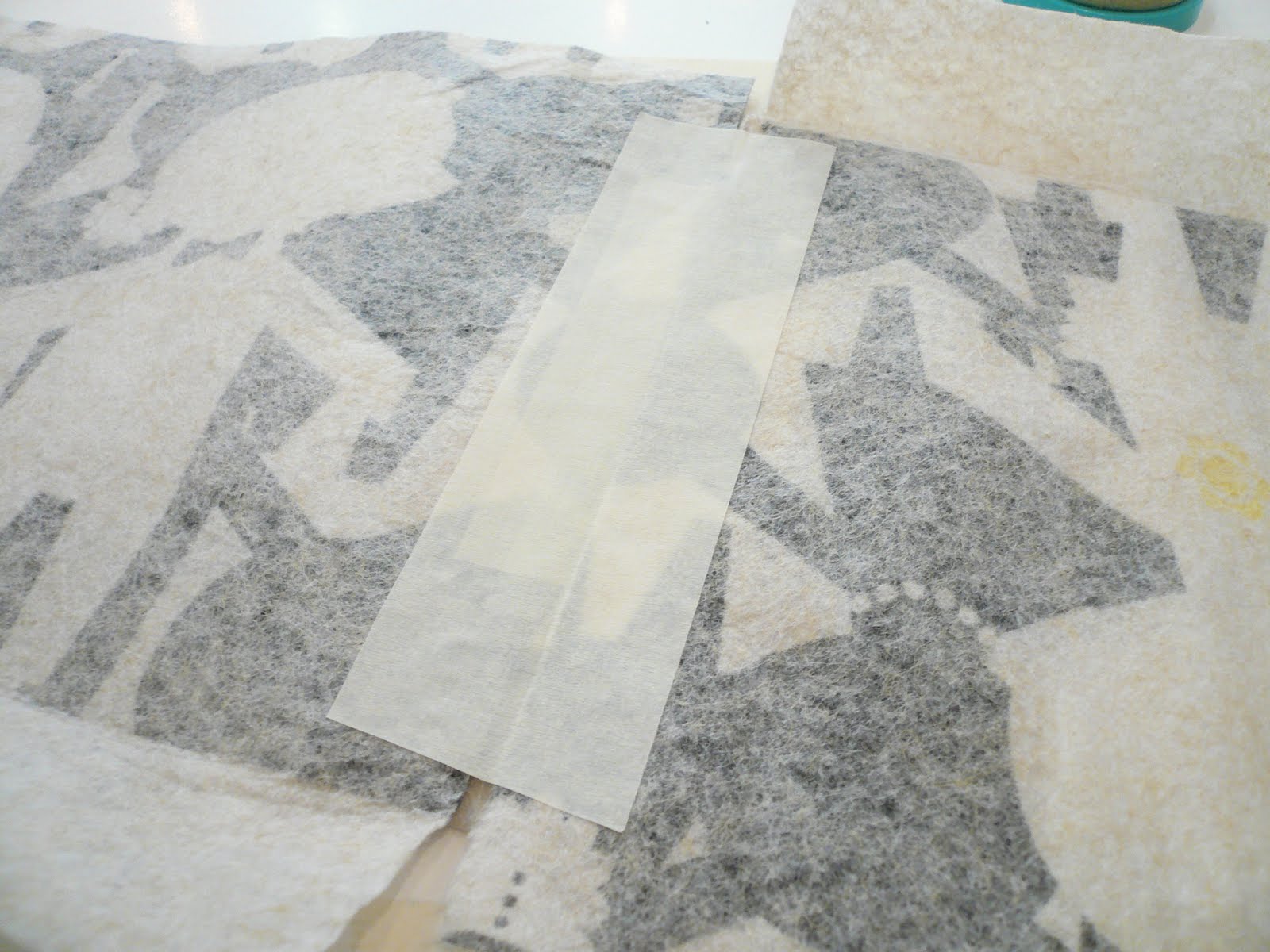
Something I did recently to make myself feel better after losing my sketchbook full of 2010 design ideas and drawings. A nicely covered, relatively weatherproof and 'hard-covered' new sketchbook which I dearly hope will never get lost!

What I had on hand:
Scissors
Sewing thread
Needles
Pins
A slightly damaged MSFW 2o10 showbag printed with cute Gorman designed graphics
Masking tape (on hindsight double-sided tape would have worked better)
Ruler


If you find yourself wondering what the hell to do with those yucky freebie polypropylene 'enviro' bags that keep getting pushed in your face, consider using the material to protect and cover a treasured book. The material is quite water-and-tear-resistant...plus you can embroider it or print onto it to create something more aesthetically pleasing. Considering how non-biodegradable the material is, it seems wiser to put the stuff to further use instead of sending it to landfill once the bag's seams come apart (which does happen quite quickly doesn't it?)

On another note, this is such a symbolic object of abuse and green-washing, isn't it? All the big brands are just jumping on the bandwagon and producing them by the millions to use as marketing collateral. Have you ever wondered how much more resources are wasted producing these bags as compared to paper bags? Not to mention the carbon footprint, greenhouse gases produced, toxic chemicals used...